Dimitris
Cartes Postales from GreeceDimitris’s pursuit of the priesthood begins as a decisive departure from his family’s expectations and ends in a crisis that he cannot resolve inside the monastery. Quiet, studious, and devoted to God, he is drawn toward religious life after visiting Mount Athos; years later, his suppressed memory of a teenage transgression returns with such force that he leaves the monastery and disappears into the mist. His arc turns on the distance between a vocation he experiences as a calling and a past he believes cannot be forgiven.
Identity and Background
Dimitris is the younger son in a household shaped by sharply different temperaments and an uneasy domestic religious life. His older brother, Giannis, is associated with football, while Dimitris never played it. He applied himself to his studies and, unlike Giannis, did not think about girls; his main preoccupation became God. The contrast is not simply between two brothers’ interests: Dimitris turns away from ordinary social and romantic life toward a demanding spiritual ideal.
Before that ideal took hold, religion reached the boys largely through their grandmother. She crossed herself whenever she passed a roadside memorial, chapel, or church, and took them to church at Easter. Their father’s authority also shaped the family’s religious practice: if he did not want his wife to attend church, she did not dispute him, having already suffered his drunken abuse. Against this background, Dimitris’s later declaration that he has been called to the priesthood marks a personal commitment, not just an inherited household routine.
Vocation and the Monastery
A schoolteacher took a group of boys to visit a monastery on Mount Athos, about fifty kilometres from home. Dimitris was changed by the visit. He later told his parents that he had been called, making clear that his choice was a serious vocation rather than a passing enthusiasm. His religious commitment sets him apart from Giannis and becomes the organizing purpose of his life.
When Giannis visits him at the monastery years later, the encounter makes visible how much that life has altered him. Dimitris arrives by a small cable car carrying a blue plastic bag of provisions that a local shopkeeper leaves below each week. His appearance shocks his brother: his hair is stale-smelling, his beard matted, and his black cardigan, knitted by hand and worn over his habit, is full of holes. The habit is flecked with unidentified stains. Giannis remembers a markedly different appearance the year before, so the visit registers not merely the austerity of monastic living but a deterioration that unsettles him.
Dimitris is sparing with words, and his brother’s teasing does not draw him into an argument. When Giannis compares confession to coffee as a quick way of feeling better, Dimitris folds his hands in his lap and looks down. He deliberately avoids answering the provocation, silently praying for calm while pressing one hand’s fingernails into the other. Yet Giannis’s mention of confession has touched a source of torment that Dimitris cannot keep at a distance.
The Return of the Past
The memory at the centre of Dimitris’s crisis is tied to a woman who had visited the monastery with her partner. During a confession, she speaks of a desire she cannot resist. Her husky, sexual voice stirs something in Dimitris’s own memory. As he listens, he sweats, struggles to concentrate, and grips the edge of his desk; the small, airless room seems to grow hotter until he is gasping and close to collapse. He suddenly understands that the sin he has been trying to suppress is his own.
Dimitris faints. When he comes to, he is on the cold stone floor, the woman gone and a visiting novice wiping his brow with a damp cloth. The stole lies twisted beneath him. The scene does not explain the teenage transgression itself; its significance lies in the force with which the memory returns and in Dimitris’s conviction that it cannot be washed away. The woman’s confession, which might have remained another person’s account of desire, becomes the occasion on which his own past breaks into the present.
Departure and Disappearance
After Giannis leaves, Dimitris can no longer endure the saints’ faces and the surrounding images of heaven and hell. The assurance of salvation has deserted him. He wonders whether his brother was right to treat coffee and confession as equally limited comforts, and he cannot find God within the monastery walls. Even the nearby caves where hermits sought solitude offer no release: there, he looks further into the darkness of his own soul. The Gospel’s warning against lustful thoughts follows him, tightening rather than easing the conflict between desire, memory, and religious judgment.
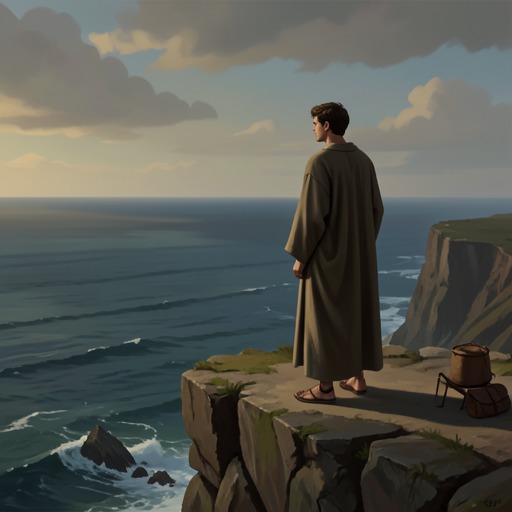
As darkness falls, Dimitris runs down a concealed path from the monastery and climbs a nearby mountain whose summit has not been built over by monks. It offers none of the angelic images or Last Judgement scenes that have become unbearable to him. Mist encircles him as Giannis, unaware of his brother’s flight, gets into his car and drives away. Dimitris’s story ends without an account of where he goes or what becomes of him. The mountain is a place outside the monastery’s imagery, but the mist prevents it from becoming a clear refuge: he escapes the walls, not the unresolved burden that has driven him out.